Why More Organizations Are Moving Toward Unified Endpoint Management
Most organizations do not wake up one morning and decide to build a complicated endpoint management environment.
It usually happens gradually.
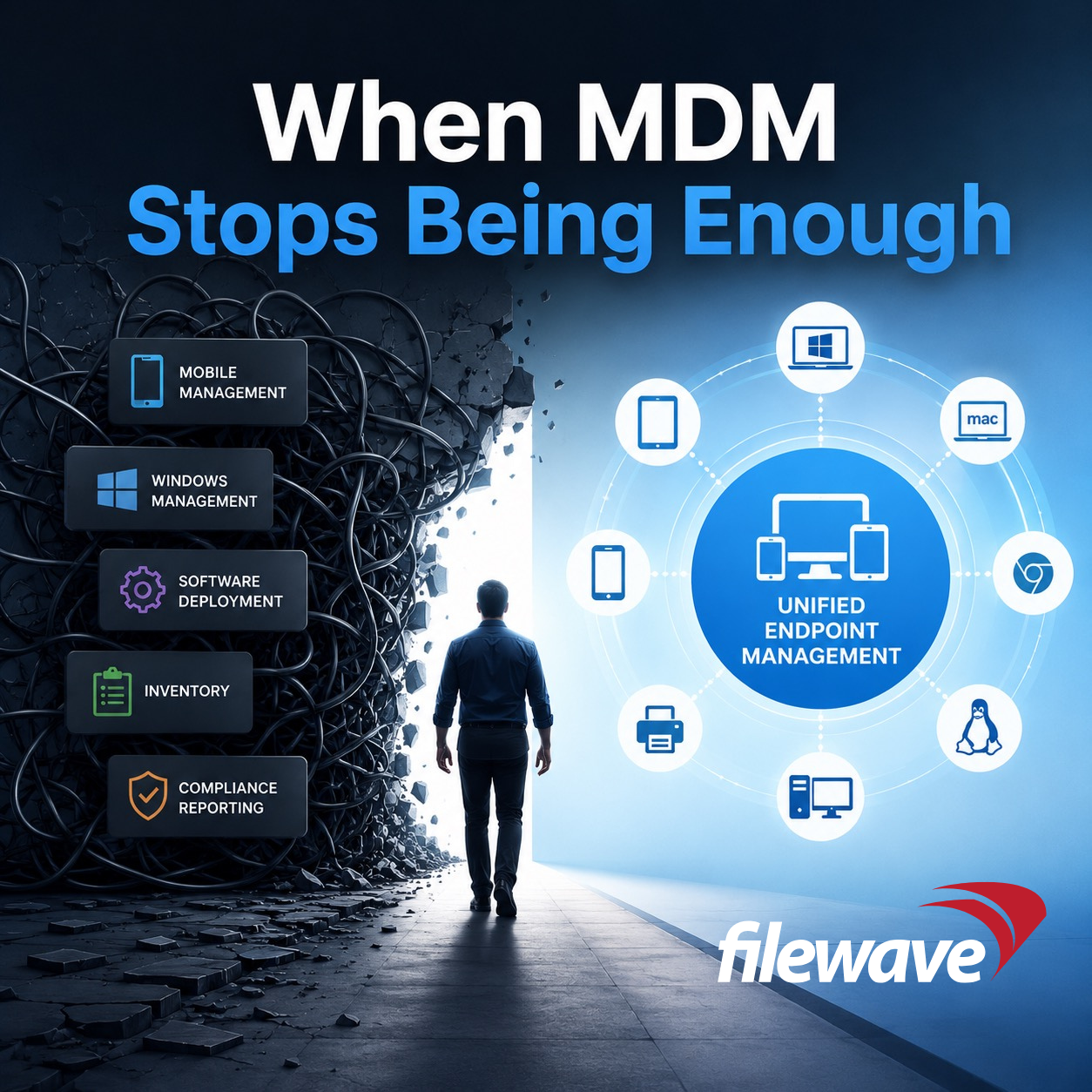
A mobile device management platform is deployed to support phones and tablets. A separate tool is likely introduced to manage Windows devices. Another platform handles software deployment. Inventory reporting lives somewhere else. Compliance reporting requires yet another system. Over time, each tool solves a specific problem, but together they create a new challenge: complexity for a stretched IT team.
What started as a straightforward endpoint management strategy becomes a collection of disconnected platforms, duplicate workflows, and fragmented visibility. IT teams spend more time moving between management consoles and less time supporting users, improving security, or driving strategic initiatives. This growing complexity is one of the primary reasons organizations are looking beyond traditional Mobile Device Management (MDM) and adopting Unified Endpoint Management (UEM) platforms.
The shift is not happening because mobile device management has become less important. Phones and tablets remain essential business tools. Instead, organizations are recognizing that mobile devices are now only one part of a much larger endpoint ecosystem that includes Windows laptops, Mac computers, Chromebooks, Linux systems, desktops, remote workstations, and a growing range of connected devices.
The challenge facing IT teams today is no longer simply managing mobile devices. It is managing all of it.
The Problem MDM Was Designed to Solve
Mobile Device Management emerged as organizations began adopting smartphones and tablets at scale. IT teams needed a way to configure devices, deploy applications, enforce security policies, and maintain visibility across mobile fleets and multiple locations.
For that purpose, MDM remains highly effective.
Organizations with relatively simple environments and a heavy focus on mobile devices may find that traditional MDM solutions continue to meet their needs. Device enrollment, application deployment, security enforcement, and remote management capabilities remain important parts of any endpoint management strategy.
The problem is that most organizations no longer operate in mobile-only environments.
Today's IT departments are often responsible for managing multiple operating systems, diverse user groups, hybrid work environments, remote employees, and increasingly complex compliance requirements. In many cases, mobile devices represent only a portion of the overall endpoint estate.
As organizations grow, the limitations of a mobile-centric management approach become increasingly apparent.
Five Signs Your Organization Has Outgrown Traditional MDM
1. You're Managing Multiple Operating Systems
Few organizations operate exclusively on a single platform anymore.
A typical environment may include Windows laptops for office staff, Mac devices for creative teams, Chromebooks for education, iPads for executives, and Android devices for field personnel. Managing each operating system through separate tools often creates inconsistent policies, fragmented reporting, and unnecessary administrative overhead.
As endpoint diversity increases, many organizations begin looking for a unified approach that provides visibility across the entire environment rather than individual device categories.
2. Your IT Team Is Juggling Multiple Management Platforms
Many organizations discover they are running three, four, or even five separate tools to accomplish what users perceive as a single function: endpoint management.
One platform manages mobile devices. Another handles software deployment. A third tracks inventory. A fourth provides reporting capabilities. Each system requires training, administration, maintenance, and support. The result is often tool sprawl rather than operational efficiency. And the hours invested in managing and maintaining these tools are a hidden cost to an organization.
When IT teams spend more time managing management tools than managing endpoints, it may be time to reconsider the overall approach.
3. Software Deployment Has Become Increasingly Complex
Application management is often one of the first areas where fragmented management environments begin to create challenges.
Deploying software consistently across Windows, macOS, ChromeOS, and other systems can become difficult when each platform is managed independently. Maintaining software versions, ensuring compliance, and troubleshooting deployment issues often requires administrators to navigate multiple consoles and workflows.
A unified endpoint management strategy can help streamline software deployment while providing greater visibility into application usage and compliance.
4. Reporting Requires Data From Multiple Systems
Security teams, auditors, insurance providers, executives, and operational leaders increasingly expect comprehensive visibility into the endpoint environment.
Unfortunately, many organizations discover that meaningful reporting requires collecting data from multiple systems and manually consolidating information. Asset inventories, software deployment status, compliance metrics, and device health data often exist in separate locations. This not only increases administrative effort but also makes it more difficult to maintain a complete and accurate picture of the environment.
5. Endpoint Complexity Is Growing Faster Than IT Resources
Perhaps the most common sign is that endpoint growth begins to outpace available resources. As organizations add users, locations, operating systems, and devices, complexity increases. Yet IT teams are rarely given additional staff in proportion to that growth.
This creates pressure to standardize processes, improve automation, and simplify management wherever possible. For many organizations, UEM becomes attractive because it helps reduce operational complexity without sacrificing visibility or control.
Why Different Industries Are Moving Toward UEM
While the underlying challenges are often similar, the drivers behind UEM adoption vary across industries.
Education: Managing Diverse Learning Environments
Educational institutions often support some of the most diverse endpoint environments in any industry. Student Chromebooks, faculty MacBooks, administrative Windows devices, classroom iPads, and shared devices may all exist within the same environment.
Managing these systems through separate tools can quickly become burdensome. As schools continue to support hybrid learning models and increasingly diverse technology ecosystems, many are looking for ways to simplify management while maintaining visibility across all devices.
State and Local Government: Doing More With Limited Resources
Government IT teams are often tasked with supporting multiple departments, diverse device fleets, and growing security requirements while operating within tight budget constraints.
For many agencies, the appeal of UEM is not simply technology consolidation. It is the ability to improve operational efficiency, standardize management practices, and gain greater visibility without increasing administrative overhead.
Healthcare: Reliability Matters
In healthcare environments, endpoint management is closely tied to operational continuity. Clinicians rely on workstations, tablets, mobile devices, and shared systems throughout the day, and downtime can directly impact patient care.
Healthcare organizations often adopt UEM strategies to improve device visibility, streamline software deployment, and maintain greater consistency across a wide range of endpoints.
Financial Services: Security, Governance, and Control
Financial institutions face unique challenges that extend beyond device management. Security and compliance remain critical concerns, but many organizations also place significant emphasis on governance, operational control, and deployment flexibility. While cloud-based management platforms continue to gain adoption, some financial institutions still prefer on-premises infrastructure because it aligns with internal policies, regulatory requirements, or broader risk management strategies.
For these organizations, endpoint management is not simply about supporting more devices. It is about maintaining control as the environment becomes more complex.
Media and Creative Organizations: Supporting Mixed Environments
Creative teams rarely operate in standardized device environments. Mac and Windows systems often coexist across departments, locations, and workflows. Specialized applications, remote collaboration, and hybrid work models add further complexity.
Many media organizations are adopting UEM platforms to simplify management while maintaining flexibility across diverse operating systems and user groups.
The Hidden Cost of Tool Sprawl
Technology purchases are often justified individually. Each platform solves a specific challenge. Each investment appears reasonable on its own. Over time, however, organizations may discover they have accumulated a collection of overlapping tools that require separate administration, licensing, training, and support.
The true cost is not always visible on a budget spreadsheet. It appears in duplicated effort. It appears in inconsistent reporting. It appears in the hours administrators spend moving between consoles, troubleshooting integrations, and manually collecting information from multiple systems.
The larger the environment becomes, the more these inefficiencies compound.
This is a big reason UEM platforms continues to gain momentum. Organizations are increasingly looking for ways to simplify management rather than add additional layers of complexity.
Why Organizations Are Reevaluating Endpoint Management Platforms
The endpoint management market has changed significantly over the past five years. Organizations that selected a platform years ago are often operating in a very different environment today.
Device diversity has increased. Remote and hybrid work have become permanent realities. Security expectations have evolved. New operating systems, deployment models, and compliance requirements have emerged.
As a result, many IT leaders are revisiting assumptions they made years ago and asking whether their current approach still aligns with the needs of the organization. For some, the answer is yes. For others, it is an opportunity to simplify operations, reduce tool sprawl, and gain better visibility across the endpoint environment.
What Organizations Should Look For in a UEM Platform
Not all UEM platforms are created equally.
Organizations evaluating UEM solutions should look beyond basic device support and consider broader operational requirements. Multi-operating-system support remains essential, but visibility, software deployment capabilities, inventory management, automation, reporting, and deployment flexibility should also factor into the decision.
Organizations in regulated industries may place additional emphasis on governance and deployment options. Others may prioritize automation, scalability, or simplified administration. Ultimately, the right platform should help reduce complexity rather than contribute to it.
Why FileWave
FileWave was built around a simple idea: endpoint management should not require multiple disconnected tools.
By providing centralized management across Windows, macOS, ChromeOS, iOS, iPadOS, and Android devices, FileWave helps organizations gain visibility across their endpoint environment while simplifying administration. Software deployment, inventory management, reporting, automation, and endpoint control are brought together within a single platform designed to support diverse environments and evolving organizational needs.
Whether supporting educational institutions, government agencies, healthcare providers, financial organizations, or creative teams, FileWave helps IT departments focus less on managing tools and more on supporting users.
Managing Complexity, Not Just Devices
The evolution from MDM to UEM is not really about mobile devices. It is about complexity and cost savings.
As organizations continue to add operating systems, users, locations, applications, and devices, endpoint management becomes less about managing individual endpoints and more about maintaining visibility and control across the entire environment.
For many organizations, Unified Endpoint Management represents the next step in that journey—not because mobile management is no longer important, but because modern environments demand a broader approach.
You can learn more and trial FileWave to determine if it can provide you the unified platform and efficiency your organization needs.
Frequently Asked Questions about UEM
What is the difference between MDM and UEM?
Mobile Device Management (MDM) focuses primarily on smartphones, tablets, and mobile operating systems. Unified Endpoint Management (UEM) extends management across Windows, macOS, ChromeOS, Linux, mobile devices, and other endpoints from a centralized platform.
When should an organization move from MDM to UEM?
Organizations often consider UEM when they begin managing multiple operating systems, supporting hybrid work environments, or relying on several separate tools for software deployment, inventory management, compliance reporting, and endpoint control.
Can UEM replace multiple endpoint management tools?
Many UEM platforms are designed to consolidate capabilities such as device management, software deployment, inventory management, reporting, automation, and compliance monitoring into a single platform, helping reduce administrative complexity.
Is UEM only for large enterprises?
No. While large organizations often adopt UEM to manage scale, small and mid-sized organizations can also benefit from simplified management, improved visibility, and reduced operational overhead.
What operating systems should a UEM platform support?
Most organizations look for support across Windows, macOS, ChromeOS, iOS, iPadOS, Android, and in some cases Linux. The ideal platform depends on the specific mix of devices in the environment.
How does a UEM improve IT efficiency?
By providing centralized visibility and management, UEM can reduce the time spent switching between tools, consolidating reports, deploying software, and maintaining multiple management platforms.
Is a UEM more secure than traditional MDM?
Security depends on the platform and implementation. However, UEM can improve visibility across the entire endpoint estate, helping IT teams apply policies consistently and identify potential gaps more quickly.
What industries benefit most from UEM?
Education, state and local government, healthcare, financial services, and media organizations often benefit from UEM because they typically manage diverse device environments and multiple operating systems.
Can UEM be deployed on-premises?
Some UEM platforms offer both cloud and on-premises deployment options. Organizations with governance, compliance, or data control requirements may prefer on-premises deployment. For example, FileWave offers its customers the ability to do Cloud or on-prem deployments while maintaining the same capabilities in both instances.
Why do organizations choose FileWave for UEM?
Organizations often choose FileWave because it combines endpoint management, software deployment, inventory management, reporting, automation, and device control within a single platform that supports multiple operating systems.
Is UEM replacing MDM?
No. UEM includes MDM capabilities but expands management beyond mobile devices to include desktops, laptops, Chromebooks, and other endpoints.
What is the best UEM solution for mixed operating system environments?
The best solution depends on organizational requirements, but many IT teams prioritize support for Windows, macOS, ChromeOS, mobile devices, software deployment, inventory management, and deployment flexibility. A UEM platform like FileWave can easily handle a mixed-OS environment.
Why are schools and government agencies moving to UEM?
Many schools and government agencies are adopting UEM to simplify management across diverse device fleets, improve visibility, and reduce operational complexity without increasing IT staffing.