Finding the vulnerability is only the beginning. The harder part is getting the fix safely deployed, verified and closed across every affected endpoint.
Most organizations today are pretty good at finding vulnerabilities. There are more tools, better threat intelligence and more data available to IT and security teams than ever before. The harder part is what happens after the vulnerability is identified.
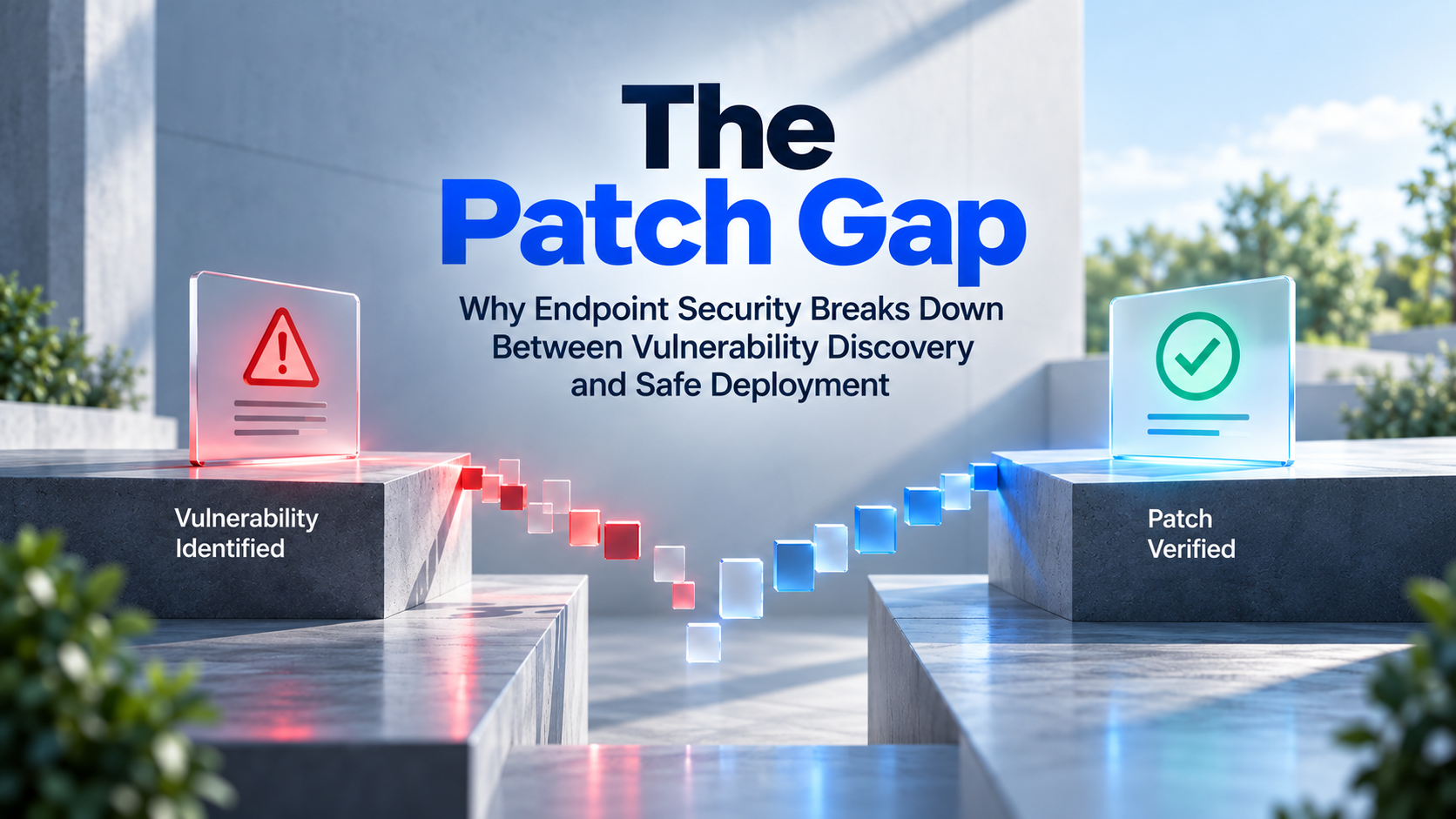
Someone still has to figure out which devices are affected, whether the patch can be safely deployed, how quickly it needs to move and whether the update actually made it onto every device. In a large or mixed environment, that can be a lot harder than it sounds. That is the patch gap: the time between knowing there is a problem and knowing it has actually been fixed.
And that gap matters because attackers are moving faster. Verizon’s 2026 Data Breach Investigations Report found that exploitation of vulnerabilities accounted for 31% of breaches, surpassing stolen credentials as the leading breach entry point for the first time in the report’s history. Verizon also reported that AI is helping attackers accelerate the exploitation of known vulnerabilities, shrinking timelines that used to take months into hours.
The issue is not simply whether an organization can find vulnerabilities. Most can identify them. The bigger question is how quickly IT can turn that information into action without creating a different problem in the process.
Patching gets complicated quickly
On paper, patching looks simple. Find the vulnerability, identify the affected devices, test the update, deploy it and make sure it worked. Now put that process into a real IT environment and it gets more complicated very quickly.
You may have Windows and macOS devices running different versions of operating systems and applications. Some users are in the office. Others are remote and may rarely connect to the corporate network. Devices are turned off, traveling, disconnected or sitting on slow connections. Older applications may depend on very specific configurations that nobody wants to disturb.
Then there is the question every IT team has to ask before pushing a significant update: what happens if this breaks something? That is where patching stops being just a security exercise. IT has to reduce exposure while also keeping the business running, and closing one vulnerability is not much of a victory if the update knocks out a critical application or creates hundreds of support tickets the next morning.
This is why patching can take longer than anyone wants it to. The IT team usually knows there is a problem. What takes time is getting comfortable enough to make the change.
The bottleneck is often confidence, not awareness
Security teams may establish that a vulnerability is serious, but IT operations still has to work through the practical details. Which devices are actually affected? Which operating systems and versions are they running? Has the update been tested against the applications people actually use? Should it go to everyone at once or to a smaller group first?
There are also the devices that do not cooperate. What happens to a laptop that is offline when the update goes out? How do you know which installations succeeded and which did not? These sound like operational details, and they are, but they are also security issues because every device that gets missed can extend the organization’s exposure.
Verizon’s 2025 research found that only about 54% of vulnerabilities affecting perimeter devices were fully remediated, with a median remediation time of 32 days. That is a good example of what the patch gap looks like in practice. The vulnerability is known. The fix may even be available. But the organization is still exposed while the operational work catches up.
Seeing the problem is not the same as fixing it
Visibility has become a major part of the endpoint security conversation, and rightly so. You cannot manage or secure devices you do not know are there. But knowing a device is vulnerable does not make it less vulnerable.
An inventory system can tell you what software version is installed. A security platform can tell you which vulnerability should be addressed first. At some point, though, that information has to turn into an action on the endpoint.
That is where disconnected tools and processes start to become a problem. One platform finds the vulnerability. Someone reviews it. Another team determines what should happen. A different tool pushes the update, and then somebody has to go back and confirm whether it worked. None of those steps is unreasonable by itself, but every handoff adds time and creates another place where something can get lost.
For IT teams managing hundreds or thousands of endpoints, visibility and execution have to get closer together. It should be easier to see what needs attention, take action and then confirm that the action was successful.
AI helps, but it does not finish the job
AI is starting to make a real difference in this process, particularly when it comes to prioritization. IT and security teams are dealing with an enormous amount of data, new vulnerabilities appear constantly and not every vulnerability represents the same level of risk.
The same is true for endpoints. A vulnerability on an isolated test machine is not necessarily the same problem as that vulnerability sitting on a device with access to critical systems. AI can help sort through that information faster, identify patterns, summarize exposure and help teams focus on the vulnerabilities and devices that deserve attention first.
IBM’s 2025 Cost of a Data Breach research found that organizations making extensive use of AI in security experienced approximately $1.9 million in cost savings compared with organizations that did not use those capabilities. IBM also connected the broader reduction in breach costs to faster identification and containment.
That is meaningful, especially as IT environments become more complex. But AI does not remove the operational work. AI may help tell you what should be fixed first, but it does not magically get the patch onto the laptop sitting in someone’s home office that has been offline for three days. It does not replace testing, staged deployments, retries or verification. Better intelligence helps, but you still have to execute.
Fast does not have to mean reckless
There is always going to be some tension between speed and stability when it comes to patching. Push an update too slowly and the organization stays exposed longer. Push it too aggressively and you risk creating an operational problem.
The answer is not choosing one over the other. It is having enough control over the deployment process to move quickly without flying blind. That may mean testing an update on a representative group of devices first. It may mean rolling the patch out in stages instead of sending it everywhere at once. It definitely means knowing what happened after the deployment started and having a way to deal with devices where the installation failed.
CISA’s vulnerability-response guidance recognizes the same challenge. It calls for rapid action when vulnerabilities are being actively exploited, while also acknowledging that patches cannot always be applied immediately because they may be unavailable, untested or operationally unsafe. In those cases, temporary mitigations may be necessary while teams prepare for deployment.
The objective should not be “patch as fast as possible” regardless of the consequences. It should be shortening the time between identifying a real risk and knowing that risk has actually been addressed.
Mixed environments make all of this harder
Most IT environments are not neat anymore. Organizations may be managing Windows laptops, Macs, mobile devices, shared systems and specialized hardware at the same time. Employees may be working from an office, a home, a hotel or an airport. Some infrastructure is in the cloud, some is on-prem and plenty of organizations are operating somewhere in between.
The security policy still has to reach all of it, and that gets harder when every part of the environment requires a different tool or process. Separate consoles, separate inventories and separate deployment workflows increase the number of places where an endpoint can be overlooked.
This is one reason the discussion around tool consolidation matters beyond cost and IT efficiency. Fewer disconnected systems can also mean fewer handoffs, better visibility into what is happening and a clearer path from identifying a problem to fixing it.
Closing the patch gap is mostly about execution
There is no magic step that closes the patch gap. IT teams still have to identify what matters, figure out which devices are affected, prioritize the work and test the fix. Then they have to deploy it, watch what happens and deal with the devices that did not respond the way they were expected to.
And then they have to verify it. That last part sounds obvious, but it is easy to confuse sending an update with completing remediation. They are not the same thing. A patch can be scheduled, pushed and reported as part of a deployment while individual devices remain untouched.
Until you know the fix reached the endpoint and was successfully installed, the job is not finished.
Better security still comes down to getting the work done
There is a lot happening in cybersecurity right now. Threat intelligence is improving. AI is changing how quickly both attackers and defenders can process information. Organizations have more ways than ever to identify vulnerabilities and understand where risk exists.
All of that is useful, but none of it changes the last mile. Eventually, the fix has to get onto the device.
As the time between vulnerability discovery and exploitation continues to shrink, the organizations that manage this well will be the ones that can connect good security intelligence with reliable endpoint execution. They can see the issue, decide what needs to happen, deploy the fix without creating unnecessary disruption and confirm that it worked.
Finding the vulnerability is only the beginning. The patch gap closes when you know the job is actually done.