The Next Big Shift in UEM: One Console to Manage Every Device
IT environments have never been more complex. What used to be a predictable mix of a few operating systems has turned into a diverse landscape of Windows laptops, Mac devices, iPhones, iPads, Android phones, Chromebooks, and many other endpoints that appear in modern workplaces. Each platform comes with its own management requirements, and in many organizations each one also has its own dedicated tool.
For IT teams, this means constantly switching between consoles to handle basic responsibilities like software deployment, policy enforcement, patching, or troubleshooting. Workflows become scattered, risks increase, and gaining real visibility becomes harder every year.
But something is changing. More organizations are realizing that this level of fragmentation is not sustainable. The future of endpoint management is moving in a clear direction: a unified approach that allows every device to be managed from a single, centralized console – unified endpoint management (UEM).
The Problem: Too Many Tools, Too Little Visibility
As device diversity grows, most IT teams find themselves managing an environment that was never designed to work together. A typical organization runs Windows devices in one department, macOS in another, iPhones and iPads in the field, Android devices for logistics, and Chromebooks in education or frontline roles. Each platform brings its own management expectations and, in many cases, its own separate console.
This is where the real challenge begins. Every time an administrator jumps from one tool to another, the workflow slows down. Simple tasks take longer. Mistakes become more likely. Blind spots appear because information is scattered rather than centralized. Security teams struggle to maintain consistent policies, and compliance becomes harder to prove.
And while productivity drops, costs quietly rise. More tools mean more licenses, more training, and more complexity that continues to build over time.
Why the Shift Is Happening Now
The growing complexity of device environments is only part of the picture. Several broader forces are pushing organizations to rethink how they manage their endpoints and to look for a more unified approach. These changes are not theoretical trends. They are showing up in daily operations and shaping the expectations placed on IT teams.
Some of the main drivers include:
- Stricter cybersecurity and compliance demands, which require faster patching and clearer visibility.
- A remote and hybrid workforce that depends on reliable support from anywhere.
- A wider range of devices and operating systems, each bringing its own requirements.
- Increased cost pressure, as overlapping tools create unnecessary spending.
- An industry-wide move toward consolidation, with organizations seeking simpler, more scalable solutions.
Together, these forces are making it clear that the old, fragmented way of managing devices is no longer sustainable.
What “One Console to Manage Every Device” Actually Means
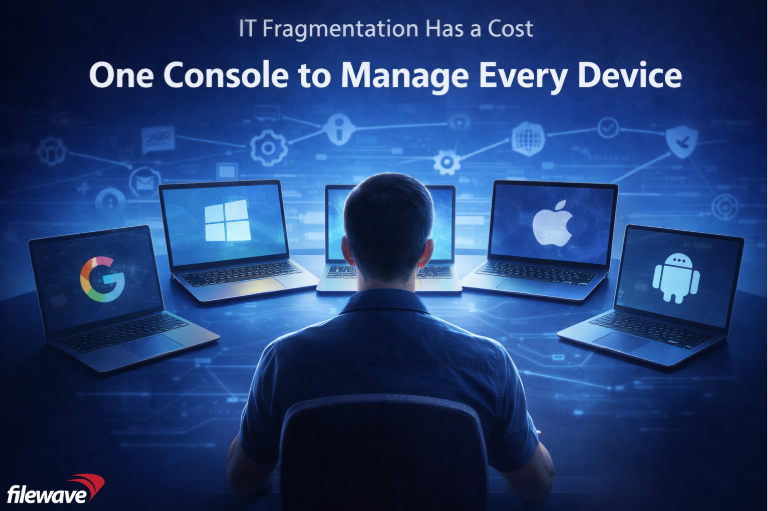
When people talk about a single pane of glass in endpoint management, the idea can sound abstract. In practice, it is a very straightforward concept. It means having one place where administrators can see what is happening across the entire device landscape and take action without jumping between different systems.
At its core, this approach brings every operating system and device type into one dashboard. Deployment, patching, imaging, configuration, and security policies follow one consistent workflow instead of being scattered across separate tools. Reporting becomes simpler as well, because insights and compliance data come from a single source rather than a mix of disconnected systems.
It also creates a cleaner experience for onboarding and offboarding users, since everything follows the same logic. And with one unified foundation, automation and remediation become far more reliable, reducing both effort and risk for IT teams.
The Core Benefits of a Single-Pane-of-Glass UEM
When every device can be managed from one place, the advantages become clear very quickly. The impact shows up in daily operations, in long-term planning, and even in the overall security posture of an organization. A single console changes how teams work and how confident they feel about the devices they are responsible for.
Here are some of the key benefits that organizations experience:
• Stronger security and compliance
A unified console gives IT teams a complete view of their environment. Patches can be applied faster, policy gaps are easier to identify, and security standards are enforced consistently across every operating system. This makes audits smoother and reduces the risk of overlooked vulnerabilities.
• Greater efficiency and faster workflows
Without the constant switching between tools, administrators follow one logic for deployment, configuration, updates, and troubleshooting. Tasks become more predictable, mistakes decrease, and IT teams gain back time that can be invested in more strategic work.
• Lower costs through tool consolidation
Maintaining multiple systems often means duplicated capabilities, overlapping contracts, and additional training. Bringing everything together in one place reduces these expenses and simplifies the entire technology stack.
• A better experience for both IT and end users
Issues are resolved faster, devices stay consistently configured, and users face fewer interruptions. IT teams feel more in control, and employees feel better supported.
• A scalable foundation for the future
New platforms, IoT devices, AI capabilities, and modern workflows can be integrated more easily when everything grows on top of one unified system. This prevents future complexity from creeping back in.
On-Premise, Cloud, or Hybrid: Why Architecture Still Matters
As organizations rethink their approach to endpoint management, the choice of architecture becomes just as important as the choice of features. Not every industry can rely on a cloud-only solution. Healthcare, finance, government, public safety, and many education environments often need an on-premise option to maintain full control over data, meet regulatory requirements, or operate in restricted networks.
At the same time, many modern IT teams prefer the flexibility of cloud-based management, especially when supporting distributed workforces. Others want a hybrid approach that combines both models, allowing them to adapt as their environment evolves.
A true single-pane-of-glass UEM has to support all of these realities. It must deliver the same experience and level of visibility regardless of where the system runs. That flexibility becomes a competitive advantage, because it allows organizations to choose what fits their needs rather than being forced into one direction.
Many vendors promise pieces of this idea, but very few deliver it in full. Which brings us to the natural question: does a platform like this actually exist?
Yes, This Actually Exists — Meet FileWave
If you’ve read this far and found yourself thinking that a single console for every device sounds almost too good to be true, you’re not alone. Many IT teams assume this kind of unified platform is still years away. The reality is different. It already exists.
FileWave was built to solve the exact challenges described in this blog. It brings every major operating system into one console and offers consistent workflows for deployment, imaging, patching, configuration, remote support, and reporting. It supports on-premise, cloud, and hybrid environments, making it a fit for organizations with strict data sovereignty needs as well as those that prefer full cloud flexibility. And with features like automation and self-healing, it helps IT teams work proactively rather than reactively.
In other words, the future of endpoint management is not a vision. It’s available right now. And FileWave is one of the platforms leading that shift.