The Cloud vs. On-Prem Debate Is Framed the Wrong Way
If you have been part of an endpoint management discussion recently, you have probably heard this question more than once: “Shouldn’t this just be cloud?” It comes up in vendor decks, architecture workshops, and leadership meetings, often framed as a simple decision. Cloud is modern. On-prem is legacy. End of story.
The problem is that this framing skips the most important part of the conversation. The real challenge is not where a system runs, but whether it fits the organization’s reality. Endpoint environments are shaped by regulation, security requirements, network constraints, and day-to-day operations. Those factors do not disappear just because a platform is cloud-hosted.
When teams rush into a deployment model before understanding their constraints, they are not choosing the wrong technology. They are choosing too early. Architecture decisions should follow risk, responsibility, and operational needs, not trends or assumptions.
This is where the debate needs to shift.
Why Vendors Push One Model and Why That’s a Problem
There is a reason the cloud versus on-prem discussion often feels one-sided. Vendors are incentivized to simplify the story. A single deployment model is easier to position, easier to sell, and easier to explain in a slide deck. “One-size-fits-all” messaging reduces friction in the buying process.
That does not make the tools bad. It makes the advice incomplete.
When architecture guidance is shaped by vendor limits instead of operational reality, complexity does not disappear. It simply moves. Teams end up bending processes to fit tooling instead of choosing tooling that supports how they actually work. That is how exception lists grow; temporary scripts become permanent, and manual work quietly fills the gaps.
For buyers, the risk is subtle but real. Decisions get optimized for simplicity on paper rather than resilience in practice. Over time, this leads to brittle environments that look clean in diagrams but struggle under real-world pressure.
So, if vendor messaging is not the right anchor, what is?
What Should Really Drive the Decision
The right deployment model is not a belief system. It is a response to real constraints.
For many organizations, security sets the boundaries first. Device trust, where enforcement happens, and how networks are segmented can immediately eliminate certain options. If policies only work when a device is online, or controls disappear from the moment connectivity drops, that is not a theoretical concern. It is an operational risk.
Compliance follows closely behind. Data residency requirements, audit expectations, and the need to produce reliable evidence all shape what is realistically possible. Some environments demand local control and predictable behavior, not because they resist change, but because accountability requires it.
Operational reality matters just as much. Distributed teams, mixed device fleets, and environments that must keep running during outages put constant pressure on endpoint management. Scale is not only about adding devices. It is about staying consistent under stress, across regions, and during moments when things do not go according to plan.
Internal maturity cannot be ignored either. Skills, processes, and existing tooling define what can be sustained over time. An architecture that looks elegant on a slide but depends on workarounds rarely survives day-to-day operations.
A useful way to frame the decision is this: what breaks first if the model is wrong? Regulation, operations, or reliability. The answer usually points in the right direction.
Architecture is not an ideology. It is accountability made operational.
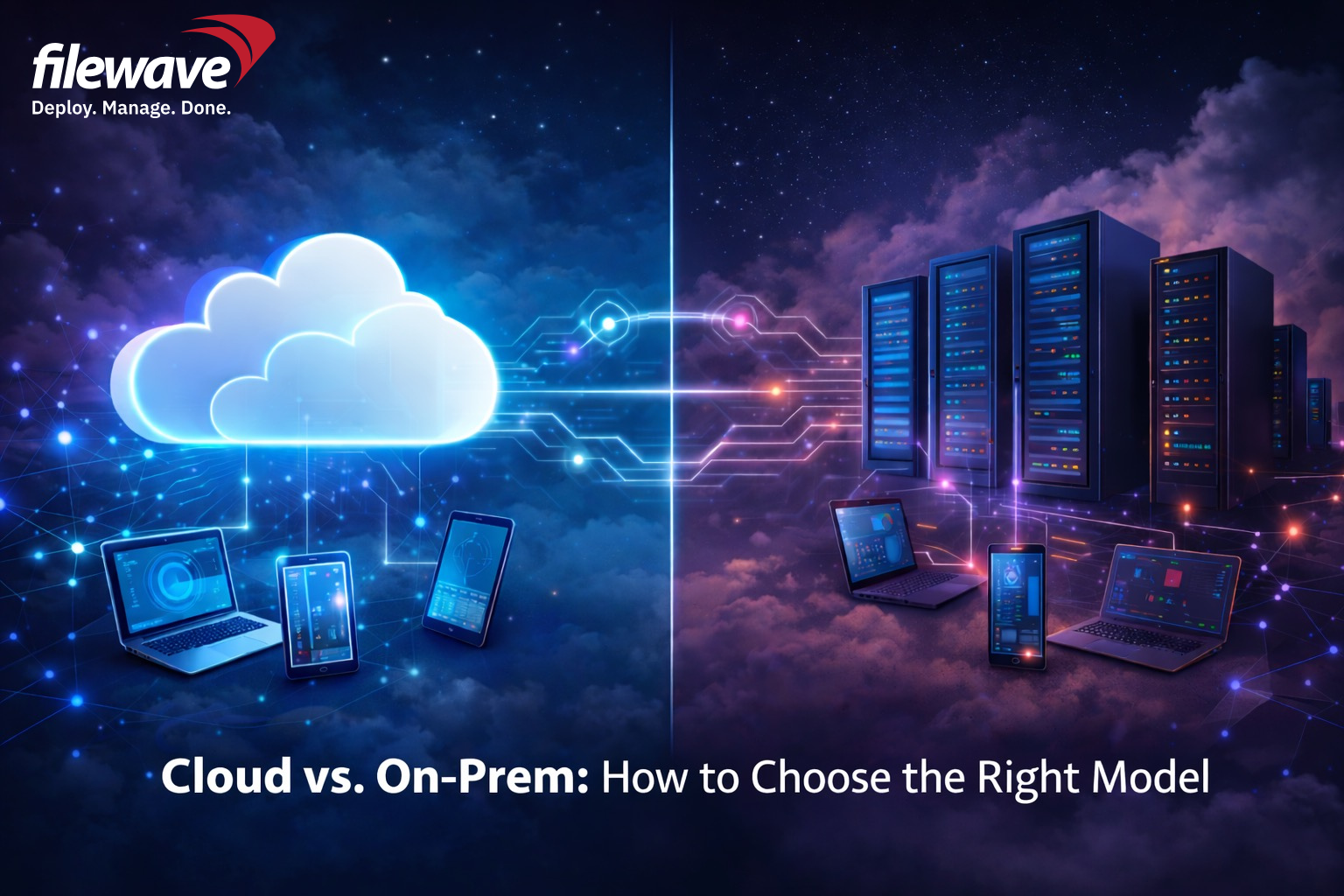
Cloud, On-Prem, Hybrid: Strengths and Trade-Offs Without Dogma
Once the conversation is grounded in real constraints, the cloud versus on-prem question becomes easier to navigate. Not because the answer is obvious, but because it stops being ideological.
Cloud-based endpoint management has clear strengths. It is fast to deploy, easy to access, and reduces the overhead of maintaining infrastructure. For organizations with distributed teams and relatively standard requirements, this model can remove a lot of friction. Centralized updates, consistent access, and straightforward scaling all work in its favor.
Trade-offs tend to surface over time. Cloud platforms rely heavily on stable connectivity and often abstract parts of the system that some organizations still need to control. In regulated environments, or in scenarios where enforcement must continue during network disruptions, these limitations become visible quickly.
On-prem endpoint management sits at the other end of the spectrum. It offers deep control, predictable behavior, and clear data locality. For industries with strict regulatory requirements, or environments that cannot depend on constant connectivity, this model provides stability and confidence. The trade-off is equally clear. Infrastructure must be operated, maintained, and secured over time, which requires discipline and ongoing effort.
Most organizations ultimately land somewhere in between. Hybrid environments are rarely the result of a carefully planned strategy. They emerge because different parts of the business face different constraints, timelines, and priorities. That messiness is not a failure. It is reality.
The key insight is simple. Endpoint environments are rarely purely cloud or purely on-prem. They are mixed, transitional, and constantly evolving. The right model is the one that can live with that complexity instead of fighting it.
The Real Risk: Locking Yourself into the Wrong Architecture
Architecture decisions have a long memory.
Once an endpoint management model is chosen, it stops being theoretical very quickly. It becomes part of daily operations. Processes are built around it. Security policies depend on it. Teams are trained to work within their limits. Changing courses later is never just a technical task. It is an organizational change, usually carried out under pressure.
The challenge is that business reality does not pause.
Organizations acquire other companies. They expand into new regions. Regulations shift. New device types appear. Remote and offline scenarios suddenly move from edge cases to critical requirements. All of this tends to happen faster than most platforms are designed to adapt.
When an endpoint management model is too rigid, the impact is subtle at first. Teams create workarounds. Exceptions become normal. Manual steps creep into processes that were meant to be automated. Shadow IT fills the gaps where the system falls short.
Over time, those compromises add up.
Replacing the platform becomes harder and more expensive. Operational complexity grows. And eventually, security teams lose confidence in their own controls, not because the people fail, but because the architecture no longer matches the environment, it is responsible for supporting them.
The biggest risk is not choosing cloud or on-prem.
The biggest risk is choosing a platform that cannot evolve as your reality changes.
At that point, architecture decisions stop being about preference and start being about resilience.
Choosing a Model Is Important. Choosing a Flexible Platform Is Critical.
Choosing between cloud, on-prem, or hybrid matters. But in practice, the bigger decision is not the model itself. It is whether the platform you choose can adapt when that model changes.
Many endpoint management platforms are built around a single assumption. Cloud only. On-prem only. One preferred way of working. That works well until business reality intervenes. New regions. New regulations. Acquisitions. New device types. Suddenly, the architecture that once felt “right” becomes a constraint.
This is where flexibility stops being a-nice –to-have and becomes a requirement.
FileWave was built for environments that do not fit into a single box. It supports cloud, on-prem, and hybrid deployments by design, without forcing teams into an architectural ideology. Policies, visibility, and enforcement remain consistent, regardless of where the management layer runs.
That ties directly back to the core themes of this discussion. Compliance needs proof. Control needs consistency. Operational reality needs room to evolve.
Good endpoint management does not lock you into an answer. It gives you the freedom to change without losing control.